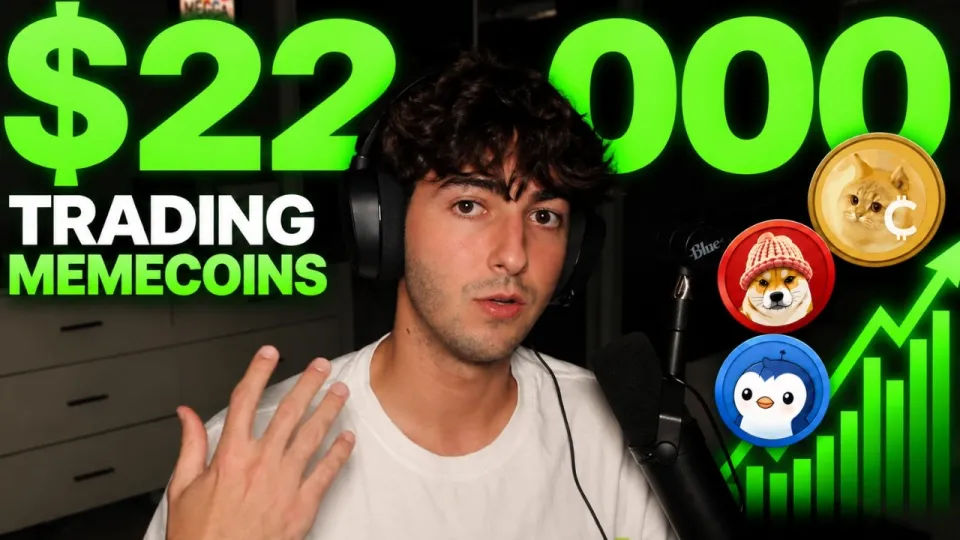
How Can One Meme Coin Trade Turn Into $22,000?
You can order the same kind of articles for your own video to boost it on YouTube and Google. Just message the Telegram bot @sat_sit_bot. It writes articles around your video, embeds the video and publishes them on popular niche websites (no ads). Try it free: 50 articles on us.
A $22,000 result from one meme coin trade is possible, but it is the product of a specific setup rather than a repeatable trick: a small early entry, a token with enough liquidity to absorb size, a defined exit before the crowd sells, and a trader who accepts that most attempts end near zero. Megga, a Fortnite pro and FaZe Clan member who also trades crypto, walks through exactly that kind of trade in his full guide, and points beginners to a free trading guide on Whop before they risk any capital.
The honest framing matters more than the number. Meme coins have no cash flow, no product and no earnings to anchor a price; what they have is attention. A five-figure outcome means the trader was early, sized correctly and sold into strength, not that the token was a good investment.
What does a $22,000 meme coin trade actually look like?
A trade of this size is built from four moving parts: entry price, position size, exit price and the ability to actually sell. If a trader puts $500 into a token at a $200,000 market cap and exits at a $10 million market cap, the position is worth roughly $25,000 before fees, which is the shape of the result Megga describes. The multiple does the work, not the starting capital.
That arithmetic hides the hard part. Meme coin liquidity is thin, so a position large enough to produce $22,000 in profit can also crater the price on the way out. Slippage, trading fees and failed transactions eat into the headline number, which is why experienced traders quote realized profit after selling, never paper gains on a chart.
The step-by-step process behind a single meme coin trade
- Pick the venue first. Megga routes trades through the Padre terminal at https://trade.padre.gg/rk/megga, which gives access to early Solana launches and shows liquidity, holders and recent buys before an entry.
- Screen for survivable tokens. Look at holder distribution, whether the deployer wallet still holds a large share, whether liquidity is locked, and how old the pool is. A token a few minutes old with a concentrated supply is a lottery ticket, not a trade.
- Size the position so a total loss is acceptable. The $22,000 outcome came from a position the trader could afford to write off; that is the only way to hold through the volatility without panic selling.
- Enter early and in one or two clips. Splitting a small order across many transactions on a thin pool raises fees and signals your intent to other traders.
- Set the exit before entry. Decide in advance what portion to sell at the first 3x, at 10x, and what stays as a runner with a trailing stop. Most five-figure meme coin trades are a series of partial sells, not one perfect top tick.
- Sell into demand. Exit in tranches while buyers are still coming in; the moment a token prints a sharp wick down, liquidity on the bid disappears.
Why KOL connections and group trading change the result
The most common criticism of large meme coin wins is that they happen inside a bubble of known accounts. When a trader with a large following buys a low-cap token, the announcement itself moves the price, and followers provide the exit liquidity. That does not make the trade fake, but it makes it unrepeatable for someone without that audience.
Megga's own results sit inside that reality: a public figure can enter a token, post about it, and sell into the reaction. A retail trader copying the same entry after the post is buying the top of the move. The practical takeaway is to treat influencer calls as a signal about attention, not as an entry price, and to check the chart and the holder list before acting.
Risk management rules that keep a meme coin account alive
Survival in memecoins is a numbers game: many small losses, a few large wins. Traders who last set hard rules before the first buy.
- Cap any single position at a fixed percentage of the account, typically 1–5%, so a rug pull is annoying rather than fatal.
- Verify the contract and the pool before buying; copy-paste addresses from official sources only, since lookalike tokens are common.
- Check that liquidity is burned or locked and that top holders do not control most of the supply.
- Use a dedicated wallet with only trading capital, never a main wallet holding long-term assets.
- Take initial capital off the table after the first double, then let the rest run.
- Accept that a rug pull can happen mid-trade; if the token cannot be sold, the loss is total.
The $22,000 figure is the outlier, not the average. A realistic expectation for a beginner is a long stretch of break-even trades punctuated by occasional winners, which is exactly why the free beginner material at https://whop.com/wiredd exists.
Common questions and doubts from traders watching the breakdown
The reaction to a five-figure meme coin trade splits into two camps: people who want a smaller-scale challenge to prove the method, and people who suspect insider coordination. Both concerns are legitimate. A $25–$100 starting bankroll faces different constraints than a large one, because fees and minimum order sizes consume a bigger share of the capital, and the exit is harder when the position is too small to matter to the pool.
The insider question deserves a direct answer as well. Trading alongside a group of friends or a known account does not guarantee profit, but it does change the information flow: earlier visibility, coordinated entries and a ready pool of buyers. Anyone testing the strategy alone should assume worse fills and slower exits, and size positions accordingly.
Tools and links from the breakdown
- Free beginner trading guide: https://whop.com/wiredd
- Trading terminal used for entries: https://trade.padre.gg/rk/megga
- Twitch: http://www.twitch.tv/megga
- TikTok: https://www.tiktok.com/@meggafaze
- Twitter: https://twitter.com/megga
- Instagram: https://www.instagram.com/fazemegga
Final takeaway on the $22,000 meme coin trade
A single meme coin trade can produce $22,000, but only when a small early entry meets a large price multiple, sufficient liquidity and a disciplined exit. The method is teachable; the outcome is not guaranteed, and the same setup that returns five figures can return zero if the token is a rug pull. Megga's breakdown is useful precisely because it shows the process behind one result rather than promising a repeat. Beginners should start with the free guide on Whop, paper-trade the workflow, and treat every position as money they can lose.
Key takeaways
- The breakdown comes from Megga, a Fortnite pro and FaZe Clan member who also trades crypto and memecoins.
- The reported result is $22,000 profit from one memecoin position, not from a series of trades.
- A free beginner trading guide is offered at https://whop.com/wiredd, and trading runs through the Padre terminal at https://trade.padre.gg/rk/megga.
- The main risks raised by viewers are KOL-driven pumps, insider groups and rug pulls, which can flip the outcome completely.
- Viewers asked for smaller-scale challenges, such as turning $25–$100 into $1,000, to test whether the method works without a large bankroll.
Questions & answers
Can a beginner realistically make $22,000 from one meme coin trade?
It is possible but statistically rare. The result requires an early entry into a token that multiplies many times over, enough liquidity to sell, and a disciplined exit. Most beginners lose money on memecoins because they buy after the move is already public and sell into falling liquidity.
How much starting capital do you need to trade meme coins?
You can start with a small amount, but fees and slippage take a larger share of a tiny bankroll. A practical approach is to use only money you can afford to lose entirely, keep positions at 1–5% of the account, and scale up only after the process is consistent.
Why do influencer meme coin trades look easier than they are?
A trader with a large following can move a low-cap token simply by posting about it, which gives them buyers for their exit. Someone copying the trade after the post is buying at a higher price with worse liquidity, so the same token can produce very different results.
What are the biggest risks in a single meme coin position?
Rug pulls, where liquidity is removed or the deployer dumps holdings, are the main risk and can wipe out the position completely. Thin liquidity, contract scams, lookalike tokens and the inability to sell during a sharp drop are the other common failure points.
Source: How I Made $22,000 in a SINGLE Memecoin Trade (FULL GUIDE) · Markdown version